
← Back to Blog
Running Science13 October 2026
The Umbrella Study 2025
Strength Training for Runners: What Does the Latest Research Tell Us?
Written by Warren
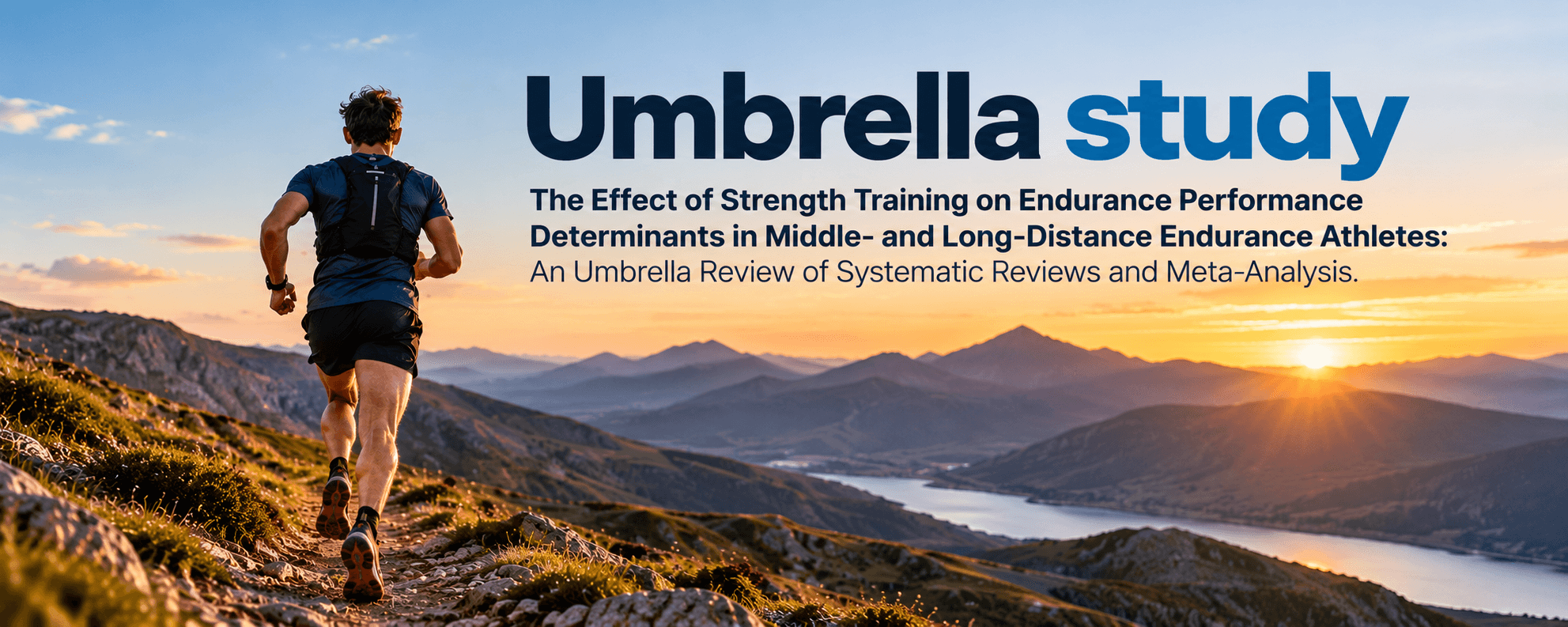
Strength Training for Runners: What Does the Latest Research Tell Us?
Why consistent strength training could be one of the most valuable additions to your running programme.
For many years, strength training was viewed by endurance runners as something secondary to running itself. Perhaps a few exercises to help prevent injuries, some core work after an easy run, or a gym session when time allowed.
But our understanding of strength training and endurance performance has developed considerably.
A 2025 umbrella review brought together findings from previous systematic reviews and meta-analyses to investigate the effects of strength training on endurance performance.
The findings support something that coaches have increasingly recognised: strength training isn't just about building stronger muscles. It can also help runners become more efficient and improve their endurance performance.
What Did the Researchers Investigate?
The research, published in April 2025 in the Journal of Strength and Conditioning Research, examined whether adding strength training to an endurance training programme could improve performance in middle- and long-distance athletes.
Rather than conducting one individual experiment, the researchers completed an umbrella review. This involves bringing together findings from multiple systematic reviews to provide a broader picture of the available scientific evidence.
The researchers analysed 17 systematic reviews, including 12 meta-analyses, examining different approaches to strength training and their effects on endurance performance.
Three types of strength training were considered:
* Maximal strength training: Heavy resistance exercises using loads greater than 80% of an individual’s one-repetition maximum.
* Explosive strength training: Exercises designed to develop force quickly, using lighter loads.
* Plyometric training: Reactive exercises such as hopping, bounding and jumping.
The researchers were particularly interested in running economy, VO₂max, endurance performance and physiological markers associated with aerobic fitness.
1. Strength Training Improves Running Economy
Perhaps the most important finding was the positive effect of strength training on running economy.
Running economy describes how much oxygen a runner requires to maintain a particular speed.
Two runners might have very similar aerobic fitness, yet one can run faster because they use less energy to maintain the same pace.
The review found moderate to large beneficial effects on running economy across the included studies examining this outcome.
This is significant because running economy is one of the important determinants of endurance running performance.
Strength training may help improve running economy through adaptations in muscular force production, neuromuscular coordination and the muscle-tendon system.
In practical terms, a runner may become more efficient at maintaining their normal training or racing pace without necessarily improving their cardiovascular fitness.
2. You Don’t Necessarily Need a Higher VO₂max to Run Faster
Another particularly interesting finding was that strength training did not produce significant improvements in VO₂max.
Four meta-analyses examined this relationship, and none identified a statistically significant improvement.
At first, this might appear disappointing. However, it highlights an important distinction between aerobic fitness and running performance.
VO₂max represents the maximum rate at which the body can take up and use oxygen during intense exercise.
Although important, VO₂max is not the only factor determining how quickly someone can run.
A runner’s performance is also influenced by running economy, lactate thresholds, fatigue resistance and other physiological characteristics.
The research suggests that strength training can improve running performance without necessarily increasing VO₂max.
In other words, runners may be able to make better use of the aerobic capacity they already possess.
3. Can Plyometric Training Improve Endurance Performance?
The review also examined the influence of plyometric training on endurance performance.
Plyometric exercises include movements such as jumping, hopping and bounding, which require muscles and tendons to absorb and produce force rapidly.
Three reviews examining plyometric training generally reported small improvements in endurance performance, although one found a large effect compared with a control group.
These findings suggest that plyometric exercises may be a useful addition to endurance training.
However, the results also indicate that the size of the benefit can vary.
For runners, this reinforces the potential value of developing not only muscular strength but also the ability to produce force efficiently during the relatively short period that the foot is in contact with the ground.
4. What Type of Strength Training Is Best?
One of the challenges highlighted by the research is the considerable variation in how strength training programmes are designed.
Different studies used different exercises, training loads, frequencies and intervention periods.
Consequently, although the overall evidence supports incorporating strength training into endurance programmes, the review does not establish one universally superior method.
For runners, a sensible approach may involve combining traditional resistance exercises with carefully progressed explosive or plyometric exercises.
For example:
* Squats and split squats to develop lower-body strength.
* Deadlifts or other hip-dominant exercises to strengthen the posterior chain.
* Calf raises to develop plantar-flexor strength.
* Hopping, bounding or jumping exercises to develop reactive strength.
The exact selection and progression should reflect the runner’s experience, existing training load and individual needs.
Importantly, strength training should complement running rather than compromise the quality of key endurance sessions.
5. How Consistent Does Strength Training Need to Be?
The umbrella review supports incorporating strength training into endurance programmes, but it does not establish a precise minimum frequency or duration that guarantees improvements.
From a practical coaching perspective, a structured programme with approximately two sessions per week is a reasonable starting point for many runners, provided the sessions are appropriately progressed and recovery is managed.
For those new to strength training, the initial focus should be on developing sound technique, movement confidence and tolerance to the exercises.
As experience develops, training can progress towards heavier resistance or more demanding explosive exercises.
Perhaps most importantly, strength training should not simply be something runners complete for a few weeks before abandoning it when their running mileage increases.
The aim should be to integrate strength work consistently into the wider training programme, adjusting the volume and intensity around important running sessions and competitions.
6. What Are the Limitations of the Research?
Although the overall findings are encouraging, the researchers identified some important limitations.
Most of the included systematic reviews were assessed as having low or critically low methodological confidence.
This reflected issues such as incomplete literature searches, insufficient explanations for excluding studies and limitations in how publication bias was addressed.
There was also considerable variation between the training programmes examined.
Therefore, while the findings support the use of strength training, we should be cautious about suggesting that every runner will experience the same improvements or that one particular strength programme is guaranteed to produce better race performances.
This is an important distinction when translating scientific findings into practical coaching recommendations.
What Does This Mean for Everyday Runners?
The key message from this research is that endurance performance is not determined by aerobic fitness alone.
Running economy and the ability to produce force efficiently also contribute to how well we perform.
For runners who already spend considerable time developing their aerobic fitness, strength training provides another opportunity to improve performance.
It doesn’t mean replacing running sessions with gym sessions, and it certainly doesn’t mean that every runner needs to become a weightlifter.
Instead, it means recognising that a well-designed strength programme can be a valuable part of becoming a more complete endurance athlete.
Whether you’re training for a 5K, half marathon, marathon or longer trail running event, there is a strong practical argument for including regular strength training alongside your running.
Final Thoughts
The 2025 umbrella review provides further support for something that should increasingly become standard practice in endurance coaching.
Strength training is not simply an optional addition intended to reduce injury risk. It is a training method with the potential to improve running economy and endurance performance.
One of the most interesting findings is that these improvements can occur without measurable increases in VO₂max.
For runners, this reinforces the idea that improving performance isn’t always about developing a bigger aerobic engine. Sometimes it’s about becoming more efficient at using the engine you already have.
The research isn’t without limitations, and further high-quality studies are needed to determine the most effective approaches.
Nevertheless, the overall evidence makes a persuasive case for including structured, progressive strength training within a balanced endurance programme.
At Run Llangollen, our approach to coaching recognises that developing as a runner involves more than simply accumulating miles. Strength training, aerobic development, appropriate recovery and consistent training all have a role to play in helping runners improve their performance over time.
⸻
Research Reference
Ramos-Campo, D. J., Andreu-Caravaca, L., Clemente-Suárez, V. J., & Rubio-Arias, J. Á. (2025).
The Effect of Strength Training on Endurance Performance Determinants in Middle- and Long-Distance Endurance Athletes: An Umbrella Review of Systematic Reviews and Meta-Analysis.
Journal of Strength and Conditioning Research, 39(4), 492–506.
DOI: 10.1519/JSC.0000000000005056
https://pubmed.ncbi.nlm.nih.gov/40153564/
Run Llangollen
Put the training into practice.
Run Llangollen provides bespoke running coaching, structured training plans and practical support for runners working towards their next goal.