
← Back to Blog
Running Science2 October 2026
THE RUN THAT GETS YOU INJURED?
THE RUN THAT GETS YOU INJURED? New research suggests a single distance spike could matter more than weekly mileage.
Written by Warren
# The Run That Gets You Injured: Why One Big Training Spike May Matter More Than Your Weekly Mileage
For years, runners have been told to be careful about increasing their weekly mileage too quickly.
The familiar “10% rule” suggests that runners should increase their total weekly running distance gradually, often by no more than around 10% from one week to the next.
But what if we have been looking at the wrong number?
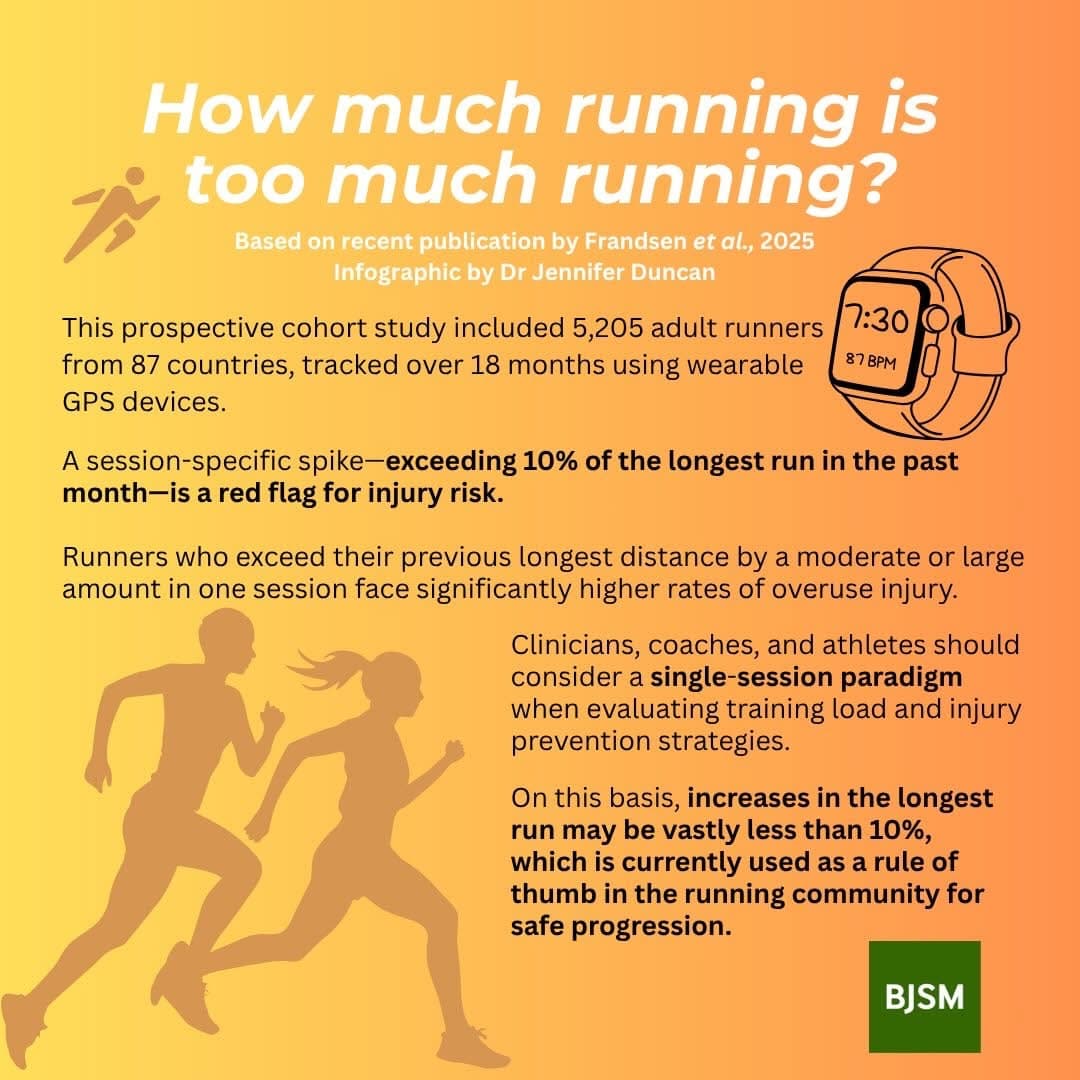
A large study involving more than 5,000 runners suggests that **the distance of one individual run may be particularly important when considering injury risk**.
Rather than simply asking:
*“How much have I increased my mileage this week?”*
Perhaps we should also be asking:
**“How much longer is this run than anything my body has recently been prepared for?”**
And for runners and coaches, that is an important distinction.
## The study
Research published in the *British Journal of Sports Medicine* followed **5,205 adult runners** for up to 18 months.
Training data were collected through Garmin devices, giving researchers information from an enormous **588,071 individual running sessions**.
During the study, 1,820 runners reported a running-related injury. Of these, 1,311 were classified as overuse injuries.
The researchers wanted to investigate whether changes in running distance were associated with the risk of developing an overuse injury.
Importantly, they looked at training load in several different ways.
They examined traditional measures based on changes in **weekly running volume**, but they also investigated something much simpler:
**How long was today's run compared with the longest run the athlete had completed during the previous 30 days?**
The results were fascinating.
## The single-run spike
The researchers divided individual runs into different categories.
A run that was no more than 10% longer than the runner's longest run during the previous 30 days was used as the reference category.
They then looked at what happened when runners went further:
- **Small spike:** more than 10% to 30% longer
- **Moderate spike:** more than 30% to 100% longer
- **Large spike:** more than 100% longer
All three categories were associated with a significantly increased rate of overuse injury compared with the reference.
The hazard rate ratio was approximately:
**1.64 for a 10–30% increase**
**1.52 for a 30–100% increase**
and
**2.28 when the distance more than doubled.**
In simple terms, the biggest distance spikes were associated with substantially greater injury rates.
That doesn't mean that increasing a long run by 11% guarantees an injury. Far from it.
But across thousands of runners and hundreds of thousands of training sessions, a clear association emerged between suddenly extending the distance of an individual run and injury.
## A simple example
Imagine a runner whose longest run during the past month has been **10 miles**.
They might be running consistently and completing something like:
Tuesday – 5 miles
Thursday – 6 miles
Saturday – 5 miles
Sunday – 10 miles
Their weekly mileage is around 26 miles.
Now imagine that the following week they run:
Tuesday – 5 miles
Thursday – 6 miles
Saturday – 5 miles
Sunday – **15 miles**
Their weekly mileage has increased from 26 to 31 miles.
That's roughly a **19% increase in weekly mileage**.
But something much more significant has happened within that week.
Their longest individual run has jumped from 10 miles to 15 miles.
That's a **50% increase in the longest run their body has recently experienced.**
Looking only at weekly mileage can therefore hide what may be an important training spike.
## Why might one long run matter so much?
Running places repeated mechanical loads through muscles, tendons, bones and connective tissues.
The body adapts to those stresses remarkably well.
In fact, training relies on this process.
We apply stress, recover from it and, given sufficient time and appropriate nutrition and recovery, the body adapts.
But adaptation isn't unlimited.
A runner may have the cardiovascular fitness to continue running considerably further than their musculoskeletal system is currently conditioned to tolerate.
This is something coaches see regularly.
A runner might comfortably complete a 10-mile run and feel aerobically capable of running another five miles.
Their breathing feels controlled.
Their heart rate looks good.
They feel strong.
So they keep going.
But cardiovascular fitness and tissue tolerance are not necessarily progressing at exactly the same rate.
Being **fit enough to complete a run** doesn't automatically mean you are **conditioned enough to absorb the training load created by it**.
That distinction becomes particularly important when preparing for half marathons, marathons and ultramarathons.
## What about the traditional 10% rule?
This is where the study becomes particularly interesting.
The researchers also investigated weekly training changes using two commonly discussed methods:
the **acute:chronic workload ratio (ACWR)** and a **week-to-week running-distance ratio**.
Neither produced the expected relationship between increasing weekly mileage and injury.
The week-to-week measure showed no significant relationship with injury risk, while the ACWR produced an inverse relationship in this dataset.
That doesn't mean weekly mileage suddenly doesn't matter.
And it certainly doesn't mean runners can increase their overall training volume without considering recovery or progression.
What it does suggest is that **weekly mileage alone may not tell us enough about the stress created by training**.
Two runners can both run 40 miles in a week while exposing their bodies to very different demands.
Runner A might distribute those 40 miles across several relatively even runs.
Runner B might run very little during the week and then complete a huge long run at the weekend.
The weekly total is identical.
The individual training stress isn't.
## Does this mean we need a new 10% rule?
Not quite.
It would be tempting to read this research and replace:
**“Never increase weekly mileage by more than 10%”**
with:
**“Never increase your long run by more than 10%.”**
But coaching and injury prevention aren't that simple.
This was an observational study.
It identifies an **association** between changes in single-session distance and injury; it doesn't prove that exceeding 10% directly causes an injury in an individual runner.
There are also many other variables involved in running injuries.
These can include previous injury history, training experience, running intensity, terrain, elevation, strength, sleep, recovery, nutrition and the athlete's overall ability to tolerate training.
The participants also weren't a perfect representation of every runner. The study population was predominantly male and largely based in Europe and North America.
So the message shouldn't be that 10% represents a magical line between safe and dangerous training.
Instead, the study gives runners and coaches another useful way of looking at training progression.
## Look at the individual run, not just the week
As a coach, this is probably the most useful practical takeaway.
When reviewing a runner's training, I don't just want to know:
**How many miles did you run this week?**
I also want to know:
**What was your longest run?**
**How does that compare with what you've done recently?**
**How hard was that run?**
**What terrain was it on?**
**How much climbing was involved?**
**What training surrounded it?**
**How well did you recover afterwards?**
Those questions provide much more context than weekly mileage alone.
For trail and fell runners this becomes even more important.
Ten miles on flat road isn't necessarily equivalent to ten miles across mountainous terrain involving steep climbing and descending.
Distance is only one component of training stress.
## Beware of the “big weekend”
One scenario where this research may be particularly relevant is the runner who misses training during the week and tries to catch up at the weekend.
Perhaps the training plan says 30 miles.
By Saturday they've only managed 12.
So they decide to make up the difference with an enormous Sunday run.
From a psychological perspective this can feel productive:
**“At least I've hit my weekly mileage.”**
Physiologically, however, you've potentially concentrated a large amount of stress into one session.
Training isn't an accounting exercise.
You don't need to repay missed miles.
Sometimes the sensible response to missed training is simply to accept that the training was missed and continue with the programme.
## Marathon and ultra training
This research also has obvious implications for endurance training.
Long runs are an essential part of marathon and ultramarathon preparation.
We need progressively longer runs because the body needs exposure to the demands of prolonged running.
The answer isn't to avoid long runs.
It's to **build the capacity to complete them progressively**.
For example, if somebody has consistently been running 14–16 miles, an 18-mile long run represents a very different proposition from an 18-mile run completed by somebody whose longest run for the past month has been eight miles.
The distance is identical.
The preparation for that distance isn't.
This is why copying another runner's session—or jumping into an event because you believe you're generally fit enough—can create problems.
Training history matters.
## What runners can take from this research
There are several useful lessons.
**Monitor your longest runs as well as your weekly mileage.**
When planning training, look back at what you've actually completed recently rather than what you think you *should* be capable of doing.
**Avoid sudden heroic long runs.**
A huge training session rarely provides a fitness benefit proportionate to the additional fatigue and stress it creates.
**Don't chase missed mileage.**
If life gets in the way of training, don't automatically cram those missing miles into another session.
**Progress long runs gradually.**
Long-run progression should reflect your recent training history, experience, recovery and the demands of your goal event.
**Remember that distance isn't the whole story.**
Elevation, terrain, intensity and duration can dramatically change the stress of a session.
And perhaps most importantly:
**Fitness is built through consistency, not individual heroic sessions.**
## The bigger coaching message
Good training isn't about seeing how much work you can survive today.
It's about applying enough stress to create adaptation while still being able to recover and train consistently tomorrow, next week and next month.
One enormous session might look impressive on Strava.
But if it compromises the next seven days of training—or contributes to an injury that removes several weeks of running—it hasn't moved your training forward.
This study adds some compelling evidence to something good coaching has always tried to achieve:
**Progress the runner's capacity rather than simply increasing the numbers on the training plan.**
Weekly mileage still gives us useful information.
But perhaps we should pay much closer attention to the size of the individual sessions hidden within that weekly total.
Because when it comes to injury risk, the question might not simply be:
**“How much did you run this week?”**
It might also be:
**“How much further did you run today than your body has recently been prepared for?”**
---
### Reference
Abrahamson J, Sjørup Simonsen N, Sandell Jacobsen J, et al. *How much running is too much? Identifying high-risk running sessions in a 5200-person cohort study.* British Journal of Sports Medicine. 2025;59(17):1203–1210. doi:10.1136/bjsports-2024-109380.
Run Llangollen
Put the training into practice.
Run Llangollen provides bespoke running coaching, structured training plans and practical support for runners working towards their next goal.